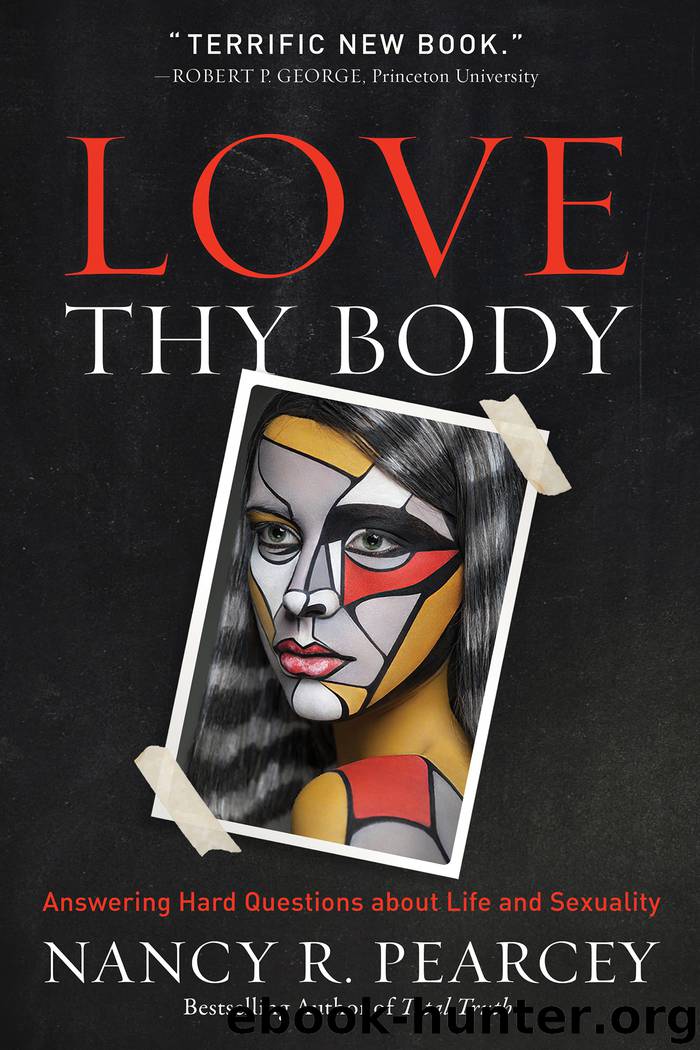
Love Thy Body by Nancy R. Pearcey
Author:Nancy R. Pearcey
Language: eng
Format: epub
Tags: Christianity / Contemporary Issues;Human body—Religious aspects—Christianity;Sex—Religious aspects—Christianity;REL067030;REL012110
ISBN: 9781493412822
Publisher: Baker Publishing Group
Published: 2017-10-03T04:00:00+00:00
Three Types of Law
What about the fact that the Old Testament refers to practices that are clearly culture-bound, like prohibitions on blending two types of fiber in cloth? How is anyone justified in picking and choosing among Old Testament laws? In the New Testament era, the most intense controversies were over just this question. Were Christians still required to practice “Jewish customs” (Gal. 2:14), like circumcision and avoiding food sacrificed to idols? The answer was no. Moral laws still apply but ceremonial and civil laws do not.72
CEREMONIAL laws were symbolic, governing temple worship—sacrifices, feasts, foods, the priesthood, worship, circumcision, and ritual purity (the clean laws). Even in Old Testament times, these laws were not universal; they were not applied to other nations. The prophets recognized the difference between moral and ceremonial laws: “I desire mercy, not sacrifice, and the acknowledgment of God rather than burnt offerings” (Hos. 6:6). Jesus quoted the same verse to get the Pharisees to grasp the distinction (Matt. 9:13). And he explicitly rejected the clean laws. “In saying this, Jesus declared all foods clean” (Mark 7:19).73
The prohibition on weaving two different fibers together was a ceremonial law, intended to symbolize purity and holiness. In fact, the history of the Old Testament is replete with symbols and foreshadowing of the Messiah.74 But no one needs foreshadowing after the reality has arrived. Paul writes, “Do not let anyone judge you by what you eat or drink, or with regard to a religious festival, a New Moon celebration or a Sabbath day. These are a shadow of the things that were to come; the reality, however, is found in Christ” (Col. 2:16–17). The early church stopped following the sacrificial laws when they understood that Christ came as the ultimate sacrifice.
CIVIL laws were necessary because Israel was a nation. Even in Old Testament times, these laws were not universal; they were not applied to other nations. They ended when ancient Israel no longer existed as a political state.
The civil law was based on the moral law, but the two were not equivalent. Jesus drew the distinction when he said divorce is morally wrong but it was permitted in civil law because people’s “hearts were hard” (Matt. 19:8). Similarly, practices such as slavery and polygamy were not presented as ideal morally but were permitted legally. By contrast, same-sex relations were not permitted morally or legally.75
MORAL laws apply universally, to all people at all times. The Bible condemns all nations, not only Israel, for greed, injustice, oppression, violence, and sexual immorality. The New Testament repeats these moral principles to indicate that they continue to be valid.
Jesus himself put his imprimatur on Old Testament sexual morality. When asked about marriage, he quoted the Genesis text as authoritative. “Haven’t you read?” he asked—implying that the text should be treated as conclusive. “At the beginning, the Creator ‘made them male and female’” (Matt. 19:4). Christians are meant to take their template for human nature from creation.
Download
This site does not store any files on its server. We only index and link to content provided by other sites. Please contact the content providers to delete copyright contents if any and email us, we'll remove relevant links or contents immediately.
The Secret Power of Speaking God's Word by Joyce Meyer(3167)
Signature in the Cell: DNA and the Evidence for Intelligent Design by Stephen C. Meyer(3125)
Real Sex by Lauren F. Winner(3006)
The Holy Spirit by Billy Graham(2942)
The Gnostic Gospels by Pagels Elaine(2526)
Jesus by Paul Johnson(2351)
Devil, The by Almond Philip C(2324)
23:27 by H. L. Roberts(2245)
The Nativity by Geza Vermes(2226)
Chosen by God by R. C. Sproul(2159)
All Things New by John Eldredge(2157)
Angels of God: The Bible, the Church and the Heavenly Hosts by Mike Aquilina(1952)
The Return of the Gods by Erich von Daniken(1927)
Angels by Billy Graham(1920)
Knowing God by J.I. Packer(1852)
Jesus of Nazareth by Joseph Ratzinger(1802)
The Gnostic Gospel of St. Thomas by Tau Malachi(1782)
Evidence of the Afterlife by Jeffrey Long(1776)
How To Be Born Again by Billy Graham(1775)
